Saskatchewan Fake Driver’S License
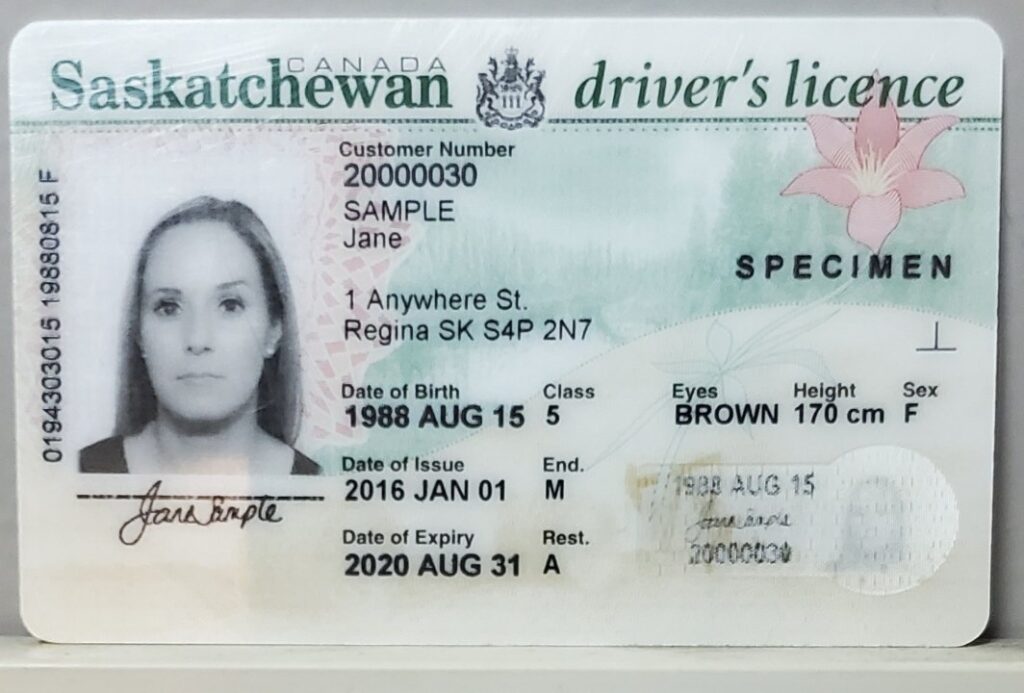
A Saskatchewan Fake Driver’S License
Premium Saskatchewan Fake Driver’S Licence
Price $150
Saskatchewan Fake Driver’s Licence:
Saskatchewan drivers licence , Saskatchewan graduated driver licensing, Class 7 learner’s licence, Class 5 Novice 1, Class 5 Novice 2, Safe Driver Recognition program, Saskatchewan demerit points, transfer out-of-province licence to Saskatchewan
Understanding Your Saskatchewan Driver’s Licence
A Saskatchewan driver’s licence comes from Saskatchewan Government Insurance, known everywhere as SGI. The province runs one of the most structured graduated licensing programmes in Canada, with six stages and a genuinely long timeline, and it’s paired with a driving-record programme that ties your behaviour directly to what you pay for vehicle insurance.
Two features define the Saskatchewan experience. The first is that the total progression to an experienced licence takes 27 months minimum — nine months as a learner, six as Novice 1, and twelve as Novice 2. If any of those periods is interrupted, the clock doesn’t just pause; in the Novice 2 stage it restarts from zero.
The second is the Safe Driver Recognition program, which every Saskatchewan driver belongs to. It works in both directions: clean years move you into the Safety Zone and earn increasing discounts on your basic vehicle insurance, while driving incidents push you toward the Penalty Zone where each negative point on the scale costs you $50.
This guide covers the whole licence: classes, the six GDL stages, fees including the new 2027 administrative charges, renewal, moving to Saskatchewan, and how the point programmes actually work.
The Classified Licence System
Saskatchewan licenses drivers by class, and the relevant ones for most people are:
Class 5 — the standard passenger vehicle licence, and the tier most drivers hold.
Class 7 — the learner’s licence, the entry point to the graduated programme.
Class 1 — Semi. Permits operating Class 1 vehicles: power units and semi-trailers, and trucks with a trailer or vehicle in tow where the gross weight of the towed units exceeds 4,600 kg. It also covers vehicles in classes 2, 3, 4, and 5. To operate a taxi, limousine, or rideshare vehicle, the driver must be authorized by SGI. It does not permit operating vehicles with air brakes, motorcycles, or school buses without the appropriate endorsements. Minimum age is 18 and not a novice driver, with approved Class 1 training, a trip inspection demonstration, and a road test in a Class 1 vehicle.
Class 2 — Bus. Permits operating buses with a seating capacity in excess of 24 passengers while carrying passengers, plus vehicles in classes 3, 4, and 5, and Class 1 vehicles as a learner with the appropriate endorsement. Minimum age 18 and not a novice driver.
Both commercial classes require the Class 1, 2, 3, 4, Basic and Sign knowledge tests, and both exclude air-brake vehicles, motorcycles, and school buses without endorsements.
Saskatchewan’s Graduated Driver Licensing Programme
If you’re a first-time driver, no matter your age, you must successfully complete all six stages of the Graduated Driver Licensing programme. That “no matter your age” clause matters — Saskatchewan doesn’t offer an adult shortcut the way some jurisdictions do.
The six stages:
- Get a Class 7 learner’s licence
- Complete driver education
- Get a Class 5 Novice 1 licence
- Practise as a Novice 1 driver
- Practise as a Novice 2 driver
- Graduate to an experienced Class 5 driver
The step-by-step sequence:
- Pass your learner’s licence (Class 7) written exams and purchase your driver’s licence at a motor licence issuer. You’ll be issued a temporary paper licence until a new driver’s licence card is sent by mail. Note the SGI warning: this new driver’s licence card is different from an SGI photo identification card and is required to drive.
- Practise driving for nine months with a supervising driver.
- Complete the required mandatory driver training education with an SGI-certified instructor.
- Pass a road test.
- Update your Class 7 licence to a Class 5 at a motor licence issuer.
- Practise as a Class 5 Novice 1 driver for six months.
- Drive as a Class 5 Novice 2 driver for 12 months with no incidents — at-fault collision, traffic conviction, and suspension free. In the event of an incident, the Novice 2 driver will be required to restart the 12-month incident-free period again from the loss date or conviction date. Interruptions such as licence suspensions, refusal to issue, or non-renewal will extend the 12 months for any period the driver did not hold a valid licence.
- Graduate to an experienced Class 5 licence.
That restart provision is the harshest single rule in the Saskatchewan programme. A single at-fault collision or traffic conviction in month eleven of Novice 2 sends you back to the beginning of the twelve months.
Requirements by Stage
| Class 7 Learner — 9 months | Class 5 Novice 1 — 6 months | Class 5 Novice 2 — 12 months | |
|---|---|---|---|
| Age | 16 years (15 in the high school programme) | 16 years | — |
| Test | Pass written test | Pass Class 5 road test | — |
| Duration | Nine months — excludes interruptions (non-renewal, refusal, suspension) | Six months — excludes interruptions | 12 months excluding interruptions and 12 months at-fault collision, traffic conviction and suspension free |
| Education | Mandatory — high school training (30 hours in-class, six hours in-car) or training from an SGI-certified driver instructor (six hours in-class, six hours in-car) | — | — |
Restrictions by Stage
| Stage | Restrictions |
|---|---|
| Class 7 Learner | Must have a supervising driver in the front passenger seat at all hours. The supervising driver must be an experienced, licensed driver. |
| Class 5 Novice 1 | One passenger only who is not an immediate family member; other passengers must be immediate family members |
| Class 5 Novice 2 | Restrictions relax as the driver progresses toward an experienced licence |
Who may supervise a learner is defined precisely: anyone with a learner’s licence can drive only with a fully licensed Class 5 driver. The supervising driver can’t be in the Graduated Driver Licensing programme and must have held a valid Canadian or U.S. driver’s licence for at least 365 days in the past three years. That 365-day-in-three-years requirement is worth checking before assuming a friend or relative qualifies.
The age entry point has one exception: applicants must be 16 or older to apply for a learner’s licence, and must have parental or guardian permission if under 18. But teenagers may get a learner’s licence at age 15, provided they are enrolled in the High School Driver Education Program.
Mandatory Driver Education
This requirement is absolute, and its consequence is worth stating plainly.
If you have a Class 7 licence, you’re not eligible for a higher class of driver’s licence unless you’ve completed one of the following programmes from an SGI-certified driver instructor:
- The high school driver education programme, or
- At least six hours in-class and six hours in-car instruction (age 16 and up)
When hiring a driving instructor, ask to see their instructor certification card to ensure it’s valid. You can find a list of SGI-certified driving instructors on the SGI website.
The driver instructor will either add your training record to your electronic SGI customer file or issue a Driver Education Certificate. And critically: if there isn’t a training record on your SGI customer file, you must present the Driver Education Certificate to the driver examiner at the time of your Class 5 road test. Turning up without either one means you can’t test.
Note the two different course structures: the High School programme runs 30 hours in-class and six hours in-car, while the certified instructor route runs six hours in-class and six hours in-car. The in-class component differs substantially between them.
What a Saskatchewan Licence Costs
Test fees:
| Test | Fee |
|---|---|
| Written test | $25 per sitting — however many exams you take in that sitting |
| Class 5 road test | $55, payable again before each new road test |
The written test fee structure is unusually fair: $25 covers a single sitting regardless of how many individual exams you take within it.
Licence fees — five years:
| Payment option | Cost |
|---|---|
| Pay in full up-front | $100 for the five-year period |
| Annual instalments | $125 total, as five annual payments of $25 — SGI sends a payment reminder each year |
| Licence issued for less than five years | Fee cut in proportion to the months of the licence, out of 60 |
The instalment option costs $25 more than paying up front, which is the price of spreading the payments. Both routes cover the same five-year term.
The 2027 Changes
Effective 1 January 2027, new administrative fees apply to driver’s licence payments. This is worth planning around now, particularly if your licence term is due to start early next year.
| Item | New fee |
|---|---|
| New or renewed driver’s licence | $15 administrative fee |
| Driver’s licence payment transactions | $2 |
| New vehicle registration | $15 |
| Vehicle registration renewal | $5 |
The $15 administrative fee applies to a five-year driver’s licence whose term starts on or after 1 January 2027, payable when you apply and with either payment option. On the instalment plan, a $2 administrative fee is also added to each annual instalment except the first. SGI may waive these fees where it considers that appropriate.
The $100 and $125 licence fees themselves stay the same — the increase is entirely in the added administrative charges.
These changes sit alongside a rise in basic plate insurance deductibles. Effective 1 January 2027, the typical $700 deductible increases to $950, and most other vehicle deductibles rise by about 20 per cent. Saskatchewan has explained the changes as offsetting costs to support the long-term sustainability of the Auto Fund, which faces pressure from inflation and rising vehicle repair costs.
The practical upshot: if your five-year term would start just after 1 January 2027, renewing before that date avoids the $15 fee and the $2 per-instalment charge.
Renewing Your Saskatchewan Licence
Your Saskatchewan driver’s licence lasts for five years. At the end of that term, you’ll need to get a new photo when you renew it.
Renewal is done in person at a motor licence issuer, before your expiry date.
Your licence expires on the last day of your birth month — or the last day of the month your immigration documents expire, where that applies. Anchoring expiry to the end of your birth month is a Saskatchewan convention worth noting when planning.
You have two payment options, as above: five annual payments of $25 totalling $125, or the full five years up front for $100.
Medical reporting is required at renewal. When you renew, you must report any medical condition that may affect your ability to drive — epilepsy, diabetes, heart disease, vision conditions, and similar. And the SGI warning is direct: failing to report medical conditions could result in a loss of insurance coverage. That’s a stronger consequence than a licence problem alone.
Security features. Saskatchewan driver’s licences offer enhanced security features and meet international standards, integrating facial recognition technology, and are issued as a one-part licence.
If a peace officer asks to see your licence and you don’t have it with you, the officer may allow you up to 48 hours to produce it. That’s a useful grace period. And if your licence includes any restrictions, you must obey them when driving.
Moving to Saskatchewan with an Out-of-Province Licence
New residents have 90 days to drive with their out-of-province driver’s licence before needing a Saskatchewan licence.
Visitors and students who aren’t Saskatchewan residents are permitted to drive under the authority of their non-Saskatchewan licence. If your licence isn’t written in English or French, it should be accompanied by an acceptable translation document, such as an International Driving Permit.
From another Canadian province or territory: you must have a valid driver’s licence from that jurisdiction, or an expired licence not older than five years is also acceptable. You can apply for a Saskatchewan licence without being tested.
Documents required. On first application you’ll provide documents proving identity, proof of residency, and entitlement to be in Canada. Each document must be from an authority such as a federal or provincial government or a federal agency, and they must be originals, not photocopies. Electronic scans may be kept on file, in keeping with Canadian standards.
For drivers from honoured countries: a valid licence and a copy of your driving record from that jurisdiction must be provided, accompanied by a translation document acceptable to SGI such as an International Driving Permit. Driver’s abstracts and records must be dated less than 30 days from the day you entered Saskatchewan — a tight freshness window worth planning around.
You’ll be asked to surrender your out-of-province licence and pay the applicable fees.
And one consequence worth stating clearly: once a Saskatchewan driver’s licence of any class is validated, the driver’s licence from any home jurisdiction becomes invalid.
If you hold a learner’s licence from another Canadian jurisdiction that’s the same as Saskatchewan’s Class 7, you’re placed into the Graduated Driver Licensing programme and must take SGI-approved driver training. So a learner’s permit from elsewhere doesn’t shortcut the Saskatchewan stages.
Saskatchewan’s Three Point Programmes
SGI operates three distinct programmes that use demerit points, and understanding which applies to you determines what an offence costs.
All three share a starting point: every driver starts at a neutral point position — zero. You accumulate demerit points through driving incidents:
- Collisions you’re responsible for
- Roadside suspensions
- Certain traffic convictions, including convictions in other provinces, territories, and states
You’re convicted when you get a ticket for a traffic offence and pay your fine, or are found guilty through the courts. The conviction then determines the penalties you face.
1. Safe Driver Recognition — The Programme Every Driver Belongs To
The Safe Driver Recognition (SDR) programme rewards safe drivers with a discount on their vehicle insurance, and ensures drivers demonstrating risky behaviour pay their share in financial penalties — helping offset the cost of the discounts for safe drivers.
It has three zones:
The Safety Zone means discounts. Each year you drive without incident you move further into the Safety Zone, earning increasing discounts on your basic vehicle insurance. As long as your rating is zero or higher, you will not pay a penalty.
Driving incidents mean demerit points. For each driving incident — collisions you’re responsible for, licence suspensions, and traffic convictions — you receive demerit points and move toward the Penalty Zone. If you remain in the Safety Zone after applying the demerit points, you will not have to pay a financial penalty. Demerit points only result in a financial penalty if you are in the Penalty Zone after applying the points.
The Penalty Zone means financial penalties. Each driving incident you’re responsible for while in the Penalty Zone results in demerit points and financial penalties. For each negative point on the scale, you pay $50. And if you experience an incident while in the Penalty Zone — moving you further into it — this results in a larger financial penalty based on your cumulative demerit points.
And the crucial detail: penalties paid through the SDR programme are on top of the fines issued by law enforcement for traffic convictions. Separately, if you’re responsible for a collision you have to pay your insurance deductible.
The Safety Rating Scale, showing the discount structure upward:
| Points | Discount |
|---|---|
| 0 | Base insurance premium (neutral zone) |
| 1 | 2% |
| 2 | 4% |
| 3 | 6% |
| 4 | 8% |
| 5 | 10% |
| 6 | 12% |
| 7 | 14% |
| 8 | 16% |
| 9 | 18% |
| 10 | 20% |
| 11 through 20 | 20% (Great driver zone) |
| 21 | 21% |
| 22 | 22% |
| 23 | 23% |
| 24 | 24% |
| 25 | 25% |
The scale rises steadily to 20 per cent at ten points, plateaus through the Great driver zone, and then continues climbing one percentage point at a time from 21 to a maximum of 25 per cent at 25 points. The plateau structure means the largest gains come early, with the incremental rewards returning only after a sustained clean record.
Discount eligibility applies to drivers who own or lease a vehicle registered in Class LV, PV, or F (one-ton model or smaller), and the discount applies to every qualifying vehicle you insure.
Appeals are available. Drivers who have had an at-fault accident receive a penalty on their safety rating. If a driver believes there are reasons their insurance rating shouldn’t be affected, they can make an appeal to the Highway Traffic Board to have their safety rating re-adjusted.
2. The Driver Improvement Programme — For Experienced Drivers
This programme applies escalating consequences based on accumulated demerit points, and the thresholds are unusually detailed:
| Consequence | Demerit points |
|---|---|
| Programme information letter | 9 or more |
| Warning letter | 12 or more |
| Defensive Driving Course | 15 or more |
| Driver Improvement Training | 18 or more |
| 30-day suspension | 21 or more |
| 90-day suspension | 24 or more |
| 180-day suspension | 27 or more |
| Driver Improvement interview and penalty | 30 or more |
| SGI manual review and penalty | 33 or more |
The progression is gradual at first — letters rather than penalties — but the suspensions at 21, 24, and 27 points mean a driver with a persistent record faces up to six months off the road. And drivers who continue high-risk behaviour face fines, driver’s licence re-testing, licence suspensions of up to six months, and completion of a driver improvement training programme.
3. The GDL Improvement Programme — For New Drivers
New drivers in the graduated programme face their own track, with increasing suspension lengths based on the number of tickets and collisions on your driving record — 30, 90, or 180 days. Because the restrictions in the Novice stages are strict, an offence here has a compounding effect: it can both trigger a GDL suspension and restart the Novice 2 twelve-month countdown.
Roadside and Administrative Suspensions
Saskatchewan’s immediate roadside suspensions are issued by law enforcement at the time you’re stopped, based on provincial laws. The Traffic Safety Act, The Driver Licensing and Suspension Regulations, and The Vehicle Impoundment Regulations give SGI authority over the rules and the consequences of breaking them.
For impaired driving, the escalating structure is significant. Across a five-year look-back for zero-to-.08 BAC and drug offences:
| Consequence | 1st offence | 2nd offence | 3rd and subsequent |
|---|---|---|---|
| Roadside licence suspension | 60 days | 120 days | 18 months |
| Vehicle impoundment | 3 days | 7 days | 14 days |
| Required programme | Driving Without Impairment (DWI) | Alcohol & Drug Education (ADE) | Addictions assessment |
| Ignition interlock installation | N/A | 120 days | 365 days |
| Ignition interlock programme | N/A | Voluntary | Mandatory |
| Interlock suspension served | N/A | 60 days | 365 days |
| Safe Driver Recognition points | −4 | −4 | −4 |
Two features stand out. Each impaired driving offence costs 4 negative points on your Safe Driver Recognition rating — which translates to a $200 penalty, plus whatever the loss of discount costs you. And a third offence brings an 18-month roadside suspension with a mandatory 365-day ignition interlock programme.
The Rules of the Road suspension applies specifically to stunting, racing, or excessive speeding — 50 km/h or more over, or more than double the posted limit — and carries an immediate roadside suspension for 7 days.
Other suspension types include:
- Defensive Driving Course suspension — you’re suspended until you successfully complete the programme if you don’t complete the DDC within the required timeframe
- Driver Improvement Training (DIT) suspension — suspended until you complete the programme
- Traffic Safety Education (TSE) suspension — suspended until you complete the programme, which is available free online
- Judgment suspension — where you failed to make a court-ordered payment for death, injury, or property damage caused by a motor vehicle, you remain suspended until you make a payment
- Consent and Undertaking suspension — where you failed to make a payment on a voluntary binding agreement following a collision
- Interview on Driving Record — where you were asked to attend an interview due to penalties on your record, or failed to attend a previously requested interview
- Habits and Conduct — where law enforcement or the court recommends suspension due to poor driving habits
Note that several of these are indefinite suspensions resolved by completing a programme rather than by serving time. And several pathways involve payment arrangements through SGI’s Central Recovery Unit or Driver Records for out-of-province judgments.
Practical Tips for Saskatchewan Drivers
- Budget 27 months minimum. Nine as learner, six as Novice 1, twelve as Novice 2 — and every stage excludes interruptions.
- Guard the Novice 2 twelve months. One at-fault collision or traffic conviction restarts it entirely.
- Check your supervising driver qualifies. They need a valid Canadian or U.S. licence for at least 365 days in the past three years, and can’t be in the GDL programme themselves.
- Get your education certificate onto your file. Without a training record or certificate, you can’t take the Class 5 road test.
- Consider renewing before 1 January 2027. A $15 administrative fee and $2 per-instalment charge apply to terms starting on or after that date.
- Pay up front if you can. $100 beats $125 for the same five-year term.
- Report medical conditions at renewal. Failing to do so can cost you insurance coverage, not just your licence.
- Track your SDR rating. Each negative point is $50, on top of the fine and your insurance deductible.
- Note the 48-hour allowance. If you’re stopped without your licence, an officer may give you up to 48 hours to produce it.
Frequently Asked Questions
How much does a Saskatchewan driver’s licence cost? A five-year licence is $100 paid in full, or $125 in five annual instalments of $25. The written test is $25 per sitting, and the Class 5 road test is $55. From 1 January 2027, a $15 administrative fee applies to licence terms starting on or after that date.
How long does Saskatchewan’s graduated licensing take? At least 27 months: nine months as a Class 7 learner, six as a Class 5 Novice 1, and twelve as a Class 5 Novice 2. The first two stages exclude interruptions; the Novice 2 stage also requires twelve months free of at-fault collisions, traffic convictions, and suspensions.
What happens if I have an incident during Novice 2? The 12-month incident-free period restarts from the loss date or conviction date. Licence suspensions, refusal to issue, and non-renewal also extend the twelve months for the period you didn’t hold a valid licence.
Is driver education mandatory in Saskatchewan? Yes. You can’t move to a higher class from a Class 7 without completing either the high school driver education programme (30 hours in-class, six in-car) or at least six hours in-class and six in-car with an SGI-certified instructor.
How does the Safe Driver Recognition programme work? Every Saskatchewan driver is in it. Clean years move you into the Safety Zone for insurance discounts; incidents add demerit points that can push you into the Penalty Zone, where each negative point costs $50. Penalties are on top of law enforcement fines, and an at-fault collision also means paying your deductible.
How long can I drive in Saskatchewan on an out-of-province licence? Ninety days after becoming a resident. A valid licence from another Canadian province or territory, or one expired not more than five years ago, can be exchanged without testing.
Why did my licence suspend in Saskatchewan? Common reasons include the GDL or Driver Improvement programmes, failing to complete a required course, an unpaid judgment or payment agreement, a missed interview, or a law enforcement recommendation. Several of these are indefinite until the underlying requirement is met.