
Michigan Fake Drivers License & Michigan Fake ID
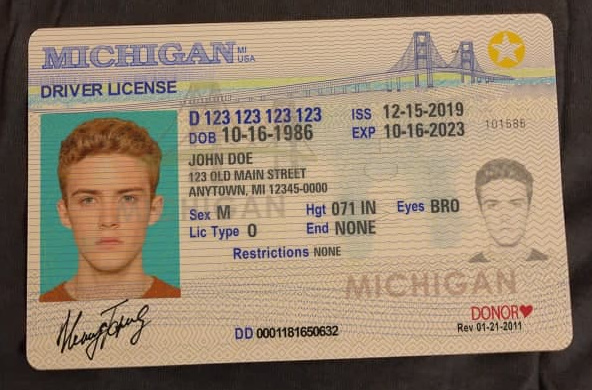
Michigan Fake Drivers License & Michigan Fake ID
Premium Michigan Fake Drivers License & Michigan Fake ID
$120.00 $100
20% discount for 3 or more IDs!
Michigan Fake Driver’s License: The Complete 2026 Guide
Michigan Fake driver’s license Secondary keywords: Michigan Secretary of State, Michigan REAL ID, Michigan Fake drivers license renewal, Michigan graduated driver licensing, Michigan GDL Level 1, Michigan enhanced driver’s license, Michigan Fake driver’s license fees, Michigan Fake drivers license points, transfer out-of-state license to Michigan
Understanding Your Michigan Fake Driver’s License
A Michigan Fake drivers license comes from the Michigan Department of State — the office residents have long called the Secretary of State. Michigan is one of the states where a single agency handles driver licensing, state identification cards, vehicle titles, and registration, which is why one office visit can cover several errands at once.
For most Michiganders, that card in the wallet does double duty. It proves you may legally operate a vehicle on public roads, and it serves as everyday photo identification for banks, employers, landlords, and airports. What follows walks through every stage of the credential’s life: getting one for the first time, choosing the right version for your needs, renewing it on schedule, and keeping it clear of the suspensions and points that can take it away.
Michigan fake driver’s license
Secondary Keywords
- Michigan fake driver’s license
- fake Michigan driver’s license
- Michigan counterfeit driver’s license
- Michigan fraudulent driver’s license
- fake ID Michigan
- Michigan fake ID
- counterfeit Michigan ID
- Michigan driver’s license fraud
- Michigan fake ID risks
- Michigan driver’s license verification
- Michigan counterfeit identification
- Michigan fake identification document
- Michigan fake license detection
- Michigan driver’s license fraud prevention
Long-Tail Keywords
- Is a Michigan fake driver’s license illegal
- What happens if you use a fake ID in Michigan
- How to identify a fake Michigan driver’s license
- Michigan fake driver’s license risks
- How are Michigan driver’s licenses verified
- Michigan fake ID detection
- What to do if your Michigan driver’s license is lost or stolen
- How to get a legitimate Michigan driver’s license
- Michigan counterfeit ID laws
- Legal alternatives to a Michigan fake ID
- How businesses detect fake Michigan IDs
- Michigan driver’s license identity verification
- What happens if you are caught with a fake license in Michigan
Michigan Fake Driver’s License: Legal Alternatives
Meta Description
Learn about Michigan fake driver’s licenses, legal risks, fraud detection, online scams, and legitimate alternatives for obtaining or replacing a Michigan driver’s license.
Michigan Fake Driver’s License: Legal Alternatives
Recommended H2 Structure
- What Is a Michigan Driver’s License?
- What Is a Michigan Fake Driver’s License?
- Why Do People Search for Fake Michigan Driver’s Licences?
- Are Fake Driver’s Licenses Illegal in Michigan?
- Risks of Using a Fake Michigan Driver’s License
- How Fake Michigan Driver’s Licenses Can Be Detected
- Online Fake ID Scams and Privacy Risks
- Fake Driver’s License vs. Novelty ID
- What to Do If Your Michigan Driver’s License Is Lost or Stolen
- How to Obtain a Legitimate Michigan Driver’s License
- What Businesses Should Know About Fake IDs
- Frequently Asked Questions
- Conclusion
FAQ
- Is a fake driver’s license illegal in Michigan?
- What happens if you are caught with a fake ID in Michigan?
- How can a Michigan driver’s license be verified?
- How do businesses detect fake Michigan IDs?
- Can a fake Michigan license be used as proof of identity?
- What should I do if my Michigan driver’s license is lost?
- How can I obtain a legitimate Michigan driver’s license?
- Are novelty Michigan driver’s licenses legal?
- Are online Michigan fake-ID sellers legitimate?
- Can a fake Michigan license create insurance problems?
Suggested Entities
- Michigan Department of State
- Michigan Secretary of State
- Michigan driver licensing
- Michigan identification documents
- Michigan identity verification
Internal Linking Opportunities
- Fake ID Laws in the United States
- How to Identify a Counterfeit ID
- Identity Theft and Fake Identification
- Lost or Stolen Driver’s License: What to Do
- Ohio Fake Driver’s License: Risks and Legal Alternatives
- Indiana Fake Driver’s License: Laws and Risks
- Illinois Fake Driver’s License: Detection and Legal Alternatives
- Wisconsin Fake Driver’s License: Legal Risks and Alternatives
The Three Michigan Credentials and How They Differ
Michigan offers three driving and identification products, and the choice you make at the counter determines how far the card will take you.
The standard license is the baseline. It’s a photo credential permitting a resident who is at least 16 to drive on public roads, issued after passing a written knowledge exam and an on-road driving skills test. It proves driving privilege and identity within the state.
The REAL Michigan Fake ID-compliant license proves the same things but meets the federal security standard for identification. Michigan marks these cards with a star — either inside a gold circle or inside a small image of the state — in the upper right corner. That star matters now. Since May 7, 2025, a REAL ID-compliant document, or another credential the TSA accepts, is required to board a domestic flight, enter a military base or nuclear power plant, or visit certain federal buildings. Converting is optional. Michigan still issues standard cards, and anyone who needs to fly can also present a valid U.S. passport, a DHS Trusted Traveler’s card, or an enhanced Michigan credential.
The enhanced license is built for border travel. It lets a Michigan resident present the card instead of a passport when returning to the United States by land or sea from Canada, Mexico, Bermuda, or the Caribbean. Enhanced cards are automatically REAL Michigan Fake ID compliant whether or not the star is printed on them.
Converting to REAL ID costs nothing extra when you do it during a renewal or replacement. Push it to a separate visit and a correction fee applies — $9 for a license, $10 for an ID. The conversion requires an in-person visit with your current Michigan license or Michigan Fake ID, proof of citizenship or legal presence, and a name-change document if your name no longer matches your legal presence paperwork. Michigan verifies documents with the issuing agency, and that verification can take more than a day. State and federal law also require the department to confirm status through the U.S. Citizenship and Immigration Service SAVE system before issuing any license or ID.
What a Michigan License Costs
| Credential | First-time | Renewal | Replace or correct |
|---|---|---|---|
| Standard driver’s license | $25 | $18 | $9 |
| Enhanced driver’s license | $45 | $38 | $24 |
| Standard state ID | $10 | $10 | — |
| Enhanced state ID | — | $30 | — |
Miss your expiration date on a standard operator, enhanced operator, or enhanced chauffeur license and a $7 late fee attaches. Standard chauffeur renewals are exempt. The fee is waived in two narrow cases: when your expiration date lands on a Saturday, Sunday, or legal holiday and rolls forward to the next business day, and when you renew after receiving a 180-day extension permit that hasn’t yet lapsed. Endorsements and commercial or chauffeur credentials carry their own pricing, and certain residents qualify for a no-fee ID.
Graduated Driver Licensing for Michigan Teens
Michigan doesn’t hand a full license to a teenager on day one. Drivers under 18 move through the graduated driver licensing system, which layers responsibility gradually across three levels and two segments of driver education. The system ends when the driver turns 18. Driver education itself is delivered by state-certified private providers rather than the state, so prices and availability vary by community.
Level 1 — the Learner’s License. A supervised learner’s credential available at 14 years and 9 months. The driver completes Segment 1 of driver education, holds the Level 1 license for at least six months, and accumulates 50 hours of supervised driving, ten of them after dark, before advancing.
Level 2 — the Intermediate License. Available at 16, after passing the driving skills test and completing Segment 2, with a clean record — no violations, no at-fault crashes — across the preceding 90 days. Advancement is automatic once the requirements are met; nobody needs to visit an office. The restrictions during this stage are where the system does its real work:
- No driving between 10 p.m. and 5 a.m.
- No more than one passenger under 21 who isn’t an immediate family member
- No cell phone use, no texting
- Seat belts for everyone in the front seat, and everyone under 16 anywhere in the vehicle
The nighttime and passenger limits step aside in specific circumstances: driving to or from work, driving as part of a job, driving to or from an authorized activity, or riding with a parent, legal guardian, or a licensed driver at least 21 whom the parent or guardian has designated.
Level 3 — the Full License. Arrives at 17 once every instructional and behind-the-wheel requirement is satisfied. Passenger and nighttime restrictions fall away, though the state encourages parents to stay engaged.
One lever worth knowing: a parent or legal guardian can hold a teen at Level 1 or Level 2, or cancel the GDL license outright, at any point before the driver’s eighteenth birthday. Making that request requires a visit to a Secretary of State office.
Getting a First Michigan License at 18 or Older
Adults bypass the GDL tiers but follow an ordered sequence nonetheless:
- Pass the written knowledge exam, taken online or at a Secretary of State office
- Pass a vision exam at a Secretary of State office
- Present required documents and have a photograph taken
- Drive with a licensed adult for at least 30 days under the Temporary Instruction Permit issued at the office
- Schedule and pass the on-road driving skills test
The skills test is administered by independent testing businesses whose examiners are authorized by the state. The department doesn’t set or regulate what those businesses charge, so it pays to call around. After a passing result, the license is processed and mailed.
Renewing a Michigan Fake Driver’s License
Michigan credentials expire every four years on the holder’s birthday, a design that makes the deadline nearly impossible to forget. Renewal opens a year before expiration and stays available for four years after, though late fees apply once you’re past the date.
Four routes exist:
- Online — with your license or ID number and the last four digits of your Social Security number, paid by card or electronic check
- By mail — using the renewal notice and return envelope the state mails out
- At a self-service station — convenient, with a small service charge
- At a Secretary of State office — where a vision test and a fresh photograph are also completed
Most residents only need an in-person visit once every twelve years, to update the photo and, for drivers, complete a vision exam. Several situations rule out remote renewal altogether. Renewing remotely the last two times forces a visit, as does a missing or outdated photograph, a license expired more than four years, a suspended, revoked, or denied status, turning 21, a change of address filed online within the last 28 days, holding both a license and a state ID on the same record, a commercial license with a hazmat endorsement, listing on the sex offender registry, and non-citizenship — because legal presence must be verified at every renewal.
Moving to Michigan with an Out-of-State License
New residents are expected to obtain a Michigan credential as soon as they establish residency; state law builds in no grace period. The conversion itself is one of the easier transitions in the country, because a valid license from another U.S. state or territory, or from Canada, converts without a written test. A vision screening and a photograph are all that’s required at the counter, and the card arrives in the mail in about two weeks.
Bring your current out-of-state or Canadian license along with proof of legal presence, proof of Social Security number, proof of identity, and two documents establishing Michigan residency. Pre-applying and scheduling an office visit ahead of time keeps the trip short. The underlying rule is consistent across every Michigan application: Social Security number, legal presence, identity, and residency all must be documented. The name and date of birth on your legal presence document have to match your identity document. When they don’t, official proof of the change is required — an original marriage certificate or a court order — and more than one document may be needed if your name has changed more than once.
Michigan’s Point System and What It Means for You
Michigan scores moving violations on a sliding scale once a conviction is entered. Points linger on your record for two years from the conviction date, and they stack faster than most drivers realize.
| Points | Representative offenses |
|---|---|
| 6 | Drunk or drugged driving, reckless driving, leaving the scene of a crash, fleeing police, causing injury or death, manslaughter or negligent homicide |
| 4 | Drag racing, exceeding the limit by 16 mph or more, any alcohol in a driver under 21 |
| 3 | Careless driving, running a red light or stop sign, improper passing, 11 to 15 mph over the limit, failing to stop for a school bus |
| 2 | 6 to 10 mph over the limit, an open alcohol container, other moving violations, refusing a preliminary breath test while under 21 |
| 1 | 1 to 5 mph over the limit |
The consequences escalate at fixed markers. Four points in two years brings a letter noting that you’ve outscored the average Michigan driver. Eight points brings a warning that a reexamination is approaching if habits don’t change. At twelve points within two years — or six or more one-point violations — a driver assessment reexamination becomes mandatory, and your privileges can be suspended as a result.
Two things are worth separating in your mind. The state’s point system and the point system your insurer uses to price your policy are unrelated; improving one doesn’t move the other. And if you believe a ticket was unjust, the venue is court when the case is heard, not the Secretary of State afterward.
Teen drivers face a parallel set of consequences. A ticket, conviction, or at-fault crash while holding Level 1 or Level 2 can delay advancement and extend the minimum time at each stage. A citation, sanction, or at-fault crash within the three months before a scheduled skills test blocks the appointment. And once a driver reaches Level 3 or a standard operator’s license, a three-year probation period begins, during which each violation may prompt a letter from the department.
Suspensions and Reinstatement
Two systems can suspend a Michigan license, and they bill separately. Ignoring a ticket can cost you the license itself. Separately, some suspensions carry court fees on top of state reinstatement costs — $45 to clear a failure to appear or failure to comply with a judgment, and $25 for a no-proof-of-insurance suspension or hold.
The practical lesson is to deal with citations the moment they arrive. A missed court date hardens into a suspension that costs considerably more to unwind than the original violation ever did.
Practical Tips for Michigan Drivers
- Renew early. Eighteen dollars beats twenty-five, and the $7 late fee is avoidable unless your birthday lands on a weekend or holiday.
- Take the free REAL ID conversion. Doing it at renewal costs nothing; doing it later costs $9.
- Price the enhanced license against a passport. At $45 initially and $38 to renew, it covers land and sea re-entry from Canada, Mexico, Bermuda, and the Caribbean for considerably less.
- Track the twelve-year photo mark. An outdated photograph forces an office visit and can block online renewal.
- Treat the GDL requirements as deadlines, not suggestions. Fifty supervised hours with ten at night, and a clean 90 days, are hard requirements, and a single violation resets progress.
- Keep points from compounding. Twelve points in two years is the threshold where privileges can be pulled rather than merely flagged.
Frequently Asked Questions
What does a Michigan driver’s license cost? A standard first-time license is $25, renewal is $18, and a late renewal is $25. An enhanced license runs $45 first-time and $38 to renew. Replacement or correction of a standard license is $9.
How long is a Michigan driver’s license good for? Four years, expiring on your birthday. Renewal opens up to a year in advance and remains possible up to four years past expiration, with late fees applying.
What restrictions apply to a Michigan GDL Level 2 driver? No driving between 10 p.m. and 5 a.m., a limit of one passenger under 21 who isn’t immediate family, no cell phone or texting, and mandatory seat belts for front-seat occupants and everyone under 16.
Is a Michigan REAL ID mandatory? No. You need one only if you plan to fly domestically, enter a military base or nuclear plant, or visit certain federal buildings. A U.S. passport, an enhanced Michigan credential, or a DHS Trusted Traveler’s card also works.
Will I have to retake tests after moving to Michigan? A written test isn’t required if you hold a current license from another U.S. state or territory or from Canada. Expect a vision test and a new photograph at a Secretary of State office.
How many points put a Michigan license at risk? Twelve points within two years, or six or more one-point violations, triggers a mandatory driver assessment reexamination at which suspension is possible. Points clear after two years from the conviction date.