
New Hampshire Fake Drivers License & New Hampshire Fake ID
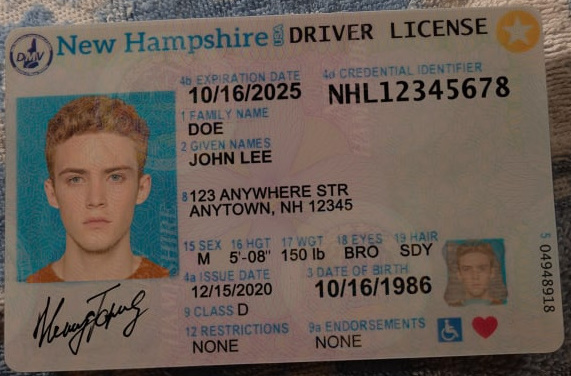
New Hampshire Fake Drivers License & New Hampshire Fake ID
Premium New Hampshire Fake Drivers License & New Hampshire Fake ID
$150.00 $100
20% discount for 3 or more IDs!
New Fake Driver’s License or New Hampshire fake ID Card | New Hampshire
New Hampshire Fake Driver’s License:
New Hampshire Fake driver’s license Secondary keywords: New Hampshire DMV, New Hampshire REAL ID, New Hampshire Fake drivers license renewal, New Hampshire youth operator license, New Hampshire demerit points, New Hampshire fake driver’s license fees, transfer out-of-state license to New Hampshire, New Hampshire license restoration
Understanding Your New Hampshire Fake Driver’s License
A New Hampshire driver’s license comes from the Division of Motor Vehicles, the New Hampshire DMV, a division of the state Department of Safety. The state runs a relatively compact licensing system — one credential class for ordinary drivers, one youth credential, and a clear set of age-banded rules that determine when your driving privilege is at risk.
Two New Hampshire features shape almost everything else. The first is that licenses expire on your birthday, specifically the fifth anniversary of your date of birth following issuance, which keeps the cycle anchored to a date you can’t forget. The second is that the demerit point thresholds change with your age, with younger drivers suspended at much lower totals than adults. A 17-year-old and a 45-year-old with the same driving record do not face the same consequences.
This guide covers the credential end to end: card types and fees, the path for new drivers under and over 18, renewal mechanics including the online rules, transferring an out-of-state license, and how demerit points actually add up.
Standard License vs. New Hampshire REAL ID
New Hampshire issues its driver’s license in two compliance versions, and the state leaves the choice to you.
A standard New Hampshire license is marked “NOT FOR FEDERAL IDENTIFICATION.” It proves your driving privilege and serves as general identification, but it won’t get you through a federal checkpoint.
A New Hampshire REAL ID carries a star in the top right corner and satisfies the federal standard. Since May 7, 2025, a REAL ID license or ID, a passport, or another federally accepted document is required to board a domestic flight or enter a secure federal facility. REAL New Hampshire Fake ID is voluntary here — you’re not required to convert.
To get one, you apply in person, either at renewal or at a dedicated upgrade appointment. The document set follows the DMV’s REAL ID checklist (DSMV 634A):
- One proof of identity
- One proof of your Social Security number
- Two proofs of New Hampshire residency
- Proof of any name change
The fee difference is modest: a REAL New Hampshire Fake ID operator license costs $60 against $50 for the standard version. If you upgrade outside your renewal cycle, a $10 replacement fee applies. The DMV suggests booking at least three months ahead of when you actually need the card, since appointment availability and document verification both take time.
What a New Hampshire Driver’s License Costs
| License type | Fee |
|---|---|
| Operator, not federally compliant | $50.00 |
| REAL ID operator, federally compliant | $60.00 |
| Youth operator | $10.00 per year up to age 21 |
| Non-U.S. citizen | $10.00 per year, not to exceed 5 years |
| Non-driver identification card | $20.00 |
| Motorcycle only, or motor driven cycle only | $55.00 |
| Moped | $8.00 |
| First-time motorcycle or 3-wheel endorsement | $30.00 |
| Motorcycle or 3-wheel endorsement renewal | $5.00 |
| Duplicate license or non-driver ID | $20.00 |
| Address change reprint | $10.00 |
Two structures stand out. The youth operator license is priced annually at $10 per year up to age 21, so the total scales with how far the applicant is from that birthday. And the non-U.S. citizen license follows the same $10-per-year model but caps at five years, reflecting that lawful presence must be verified at each renewal.
The New Hampshire Youth Operator License
New Hampshire doesn’t use the term “graduated licensing” the way most states do, but it runs an equivalent structure with a specific credential at the end.
Residents may begin learning to drive at 15½ but must be at least 16 to apply for a driver’s license. Anyone under 18 must complete an approved driver education program and provide written permission from a parent or guardian. Driver education is available through more than 60 commercial driving schools licensed by the DMV, plus some public high schools.
Any applicant over 16 and under 21 who meets the licensing requirements receives a Youth Operator License rather than a standard one. The physical difference is obvious: youth operator licenses are oriented vertically instead of horizontally, and they carry the statement “Under 21 until (date)” on the face. That design makes the holder’s age visible at a glance, which matters in a state with zero tolerance for underage alcohol offenses.
New Hampshire law also provides for temporary licenses issued to youth operators transitioning to standard operator licenses, available up to 30 days before their 21st birthday — though the physical card is delivered only on or after that birthday.
Applying for Your First New Hampshire License
The state administers three tests for driver licensing: a vision test, a knowledge test, and a road test. All three are by appointment only, and the vision and knowledge tests must be completed successfully before you can schedule a road test.
Road test availability varies by location. If same-day appointments happen to be open, you may be able to take the road test on the same day as the knowledge test — otherwise you’ll be given an appointment for another day.
Requirements for a first-time applicant include:
- A completed Application for Driver License (DSMV 450)
- Proof of identity and residency, per the checklist for the license type you want — REAL ID compliant (DSMV 634A) or non-compliant (DSMV 634B)
- The appropriate fee
- The vision test
New Hampshire also offers non-driver identification cards to residents who don’t hold a valid driver’s license, available from age 12, requiring the same documentation as a license. A REAL New Hampshire Fake ID version of the non-driver New Hampshire Fake ID is available.
Renewing a New Hampshire Driver’s License
The DMV mails a renewal notice approximately two months before your license expires. The critical caveat: you will not receive a notice if your mail is being forwarded, if you moved without notifying the DMV of your new address, or if your license is suspended. Renewal is the applicant’s responsibility, and if no notice arrives, you’re still expected to appear at any DMV location and renew before the expiration date.
Online renewal is available if you’re eligible, and eligibility is stated on the renewal notice mailed to you. State law sets a firm limit here: a license may be renewed online only once in every other renewal cycle, and the next cycle requires an in-person appearance at a licensing facility. Online renewal also requires that you’re otherwise eligible, that you don’t need to submit to a road test, that you’ve provided sufficient proof of meeting visual acuity requirements, and that the division holds a computerized image of you on file.
In-person renewal requires:
- A completed Application for Driver License (DSMV 450), or Commercial Driver License Application (DSMV 312) for a CDL
- Proof of identity — bring your current license. If you can’t locate it, you must provide alternative proof. If your image is on file, that image may serve as proof of identity
- A vision test
- The renewal fee
- REAL New Hampshire Fake ID documents, if you’re upgrading
There’s a specific exception worth knowing about. If you’ve requested and been granted an image waiver under RSA 260:14, VIII-a, you must appear in person and bring two forms of identification to renew, whichever license type you hold.
Expired licenses are handled by how long they’ve been lapsed:
- Less than one year expired — renew as usual at any DMV office. Non-U.S. citizens follow the separate renewal path for non-citizens.
- More than one year but less than three years expired — bring proper identification and residency documentation for your license type to any DMV office.
Planning to be out of state? You may apply for renewal up to six months in advance if you’ll be temporarily away at renewal time. If you don’t renew before leaving and won’t return before expiration, you must notify the DMV in writing to be eligible for a six-month temporary license.
Transferring an Out-of-State License to New Hampshire
New Hampshire gives you 60 days from establishing bona fide residency to obtain a New Hampshire license. That deadline is statutory, under RSA 263:35, and one group gets an extension: H-2A temporary agricultural workers who satisfy the requirements have up to 300 days.
Anyone who ceases to be a New Hampshire resident within those 60 days without having obtained a license must notify the director of their departure.
Applicants at least 18 years old transfer by making an appointment at a DMV office and bringing:
- A completed Application for Driver License or Non-Driver New Hampshire Fake ID (DSMV 450)
- Proof of identity and residency, per the checklist for the license type
- The appropriate fee
- A vision test
Only a vision test is required for drivers new to New Hampshire holding a valid out-of-state license. The testing picture changes if your former license has lapsed: if it has been expired for more than one year, you’ll need to pass the vision, knowledge, and road tests.
One restriction worth understanding: new residents may apply for a license for a different class of vehicle than they currently hold, but the appropriate written and road tests for that class must be successfully completed. So transferring a car license while hoping to also pick up, say, a motorcycle endorsement isn’t a single unexamined transaction.
The New Hampshire Demerit Point System
New Hampshire assesses demerit points after court conviction, and critically, suspensions are calculated based on the violation date rather than the conviction date. Points are assigned under administrative rule Saf-C 212.02.
The thresholds vary by age, and this is the system’s defining feature:
| Age group | 1 calendar year | 2 calendar years | 3 calendar years |
|---|---|---|---|
| Under 18 | 6 points = up to 3 months | 12 points = up to 6 months | 18 points = up to 1 year |
| Under 21 | 9 points = up to 3 months | 15 points = up to 6 months | 21 points = up to 1 year |
| 21 and older | 12 points = up to 3 months | 18 points = up to 6 months | 24 points = up to 1 year |
Read the under-18 row against the adult row and the practical effect is stark. Six points — two speeding convictions on most roads — can suspend a 17-year-old’s license, while an adult would need double that within the same period.
Point values by violation. The schedule is detailed and keyed to specific statutes:
| Points | Representative violations |
|---|---|
| 1 | Operating without possession of a registration certificate; failure to obey inspection requirements; failure to obtain a New Hampshire driver’s license |
| 2 | Unregistered vehicle; allowing an improper person to operate a motor vehicle; failure to display or produce a license for inspection; allowing an improper person to drive a commercial vehicle; failure to abide by license restrictions; operating with the improper class of license; operating without a motorcycle license; disobedience to a police officer; littering; operating a moped without a driver’s license; failure to report injury to a dog or cat; failure to display parking lights |
| 3 | Disobedience to a traffic control device; driving left of center; one-way and rotary traffic violations; driving on laned roadways; following too closely; driving on divided ways; driving on a sidewalk; failure to yield right of way; vehicle turning left; failure to obey yield or stop signs; entering a way from a private road or driveway; failure to yield to emergency vehicles; failure to use due care; failure to signal a turn; improper conduct at a railroad crossing; speeding under 25 mph above the posted limit; misuse of plates; illegal backing; obstruction of the driver’s view; improper opening or closing of vehicle doors; coasting; following fire apparatus too closely; carrying passengers in an undesignated truck bed; failure to display lights |
| 4 | Speeding 25 mph or more above the posted limit |
A few mechanics reduce the hit in some cases. If a single incident results in several convictions, points are assessed for only the highest-value offense rather than stacking. And convictions in other states are assessed points as well — the director may assign points for out-of-state offenses that would be grounds for assessment if committed in New Hampshire.
The driver improvement course credit. New Hampshire allows up to 3 points off your most recent suspension-purpose total by completing an approved driver improvement course, but no more than once in three complete consecutive calendar years. That’s a meaningful restriction for a driver who has already used the credit recently.
Separate SR-22 pressure points apply beyond the point totals. New Hampshire layers in financial responsibility requirements for drivers with four or more speeding convictions in one calendar year, and for a second reckless driving conviction within five years.
Suspension, Restoration, and Fees
New Hampshire treats restoration as a checklist rather than a simple payment. The fee is real, but it comes after the court, insurance, or treatment work is done.
| Item | Fee |
|---|---|
| License or operating privilege restoration | $100 |
| Commercial driver license or operating privilege restoration | $100 |
| Original, youth operator, or license | $50 |
| Registration privilege restoration | $25 |
| Single registration privilege restoration, possibly in addition | $25 |
Two routes are worth noting. Under RSA 263:42, the normal restoration fee is $100 whenever a license has been suspended or revoked, with a reduced $50 restoration fee for a suspension under RSA 263:14 involving an original or youth operator license. For default and nonpayment suspensions under RSA 263:56-a, reinstatement requires both the statutory fee and actual appearance, payment, compliance with the court’s order, or a demonstration of financial inability to pay or comply.
Accident-based financial responsibility is its own track. Under RSA 264:3 and 264:7, the suspension stays in place until you post security or resolve the claim through release, judgment, or satisfaction — and then you must give and maintain proof of financial responsibility going forward.
One administrative fee catches people mid-process: if a traffic citation has not been received within 30 days of the date it was issued, a $50 administrative late fee is imposed. That’s a mail problem that becomes a money problem.
The suspension authority is broad. Under RSA 263:56, the director may suspend or revoke any license after a hearing on a showing that the driver has committed an offense requiring mandatory revocation, has been convicted with such frequency of serious traffic offenses as to indicate disregard for safety, or is an habitually reckless or negligent driver under the point system, a record of accidents, or other evidence. The director may also consider evidence received from a law enforcement agency of misuse or abuse of driving privileges.
Practical Tips for New Hampshire Drivers
- Know your age band before you know your point total. Six points is a real risk for a teen and a non-event for an adult.
- Renew online at most every other cycle. State law limits online renewal to once in every other renewal cycle, and the following cycle requires an in-person visit.
- Keep your address current with the DMV. A forwarded or undeliverable renewal notice means no notice at all, and renewal remains your responsibility.
- Apply for REAL New Hampshire Fake ID well ahead of travel. The DMV suggests booking about three months in advance to allow for document verification.
- Mind the 60-day residency deadline. It’s statutory, and only qualifying H-2A workers get the 300-day version.
- Watch the 25 mph speeding line. Speeding under 25 over is 3 points; 25 or more over jumps to 4.
- Don’t plan on stacking the course credit. Three points off, once in three consecutive calendar years.
- Return citations promptly. Thirty days without receipt of a ticket triggers a $50 administrative late fee.
Frequently Asked Questions
How much does a New Hampshire driver’s license cost? A standard operator license is $50, and a REAL New Hampshire Fake ID operator license is $60. A youth operator license is $10 per year up to age 21. Duplicates and address change reprints are $20 and $10 respectively.
How long is a New Hampshire Fake driver’s license valid? Licenses expire on the fifth anniversary of your date of birth following issuance — in practice, roughly a five-year cycle anchored to your birthday.
Can I renew my New Hampshire Fake Drivers license online? Sometimes. Online renewal is available to eligible drivers as stated on your renewal notice, but state law allows it only once every other renewal cycle. The next cycle requires an in-person appearance.
How many points suspend a New Hampshire license? It depends on age. Drivers under 18 face suspension at 6 points in one year, 12 in two, or 18 in three. Drivers under 21 hit the thresholds at 9, 15, and 21. Drivers 21 and older at 12, 18, and 24.
Do I have to take tests when I move to New Hampshire? Only a vision test, if you hold a valid out-of-state license. If your former license has been expired more than one year, you’ll need the vision, knowledge, and road tests.
How long do I have to get a New Hampshire license after moving? Sixty days from establishing bona fide residency. Qualifying H-2A temporary agricultural workers have up to 300 days.
What is a New Hampshire youth operator license? The credential issued to drivers over 16 and under 21. It’s oriented vertically rather than horizontally and carries “Under 21 until (date)” on its face.
Can I remove points in New Hampshire? Yes, up to 3 points off your most recent suspension-purpose total by completing an approved driver improvement course — but only once in three complete consecutive calendar years.
New Hampshire fake driver’s license
Secondary Keywords
- New Hampshire fake driver’s license
- fake New Hampshire driver’s license
- New Hampshire counterfeit driver’s license
- New Hampshire fraudulent driver’s license
- fake ID New Hampshire
- New Hampshire fake ID
- counterfeit New Hampshire ID
- New Hampshire driver’s license fraud
- New Hampshire fake ID risks
- New Hampshire driver’s license verification
- New Hampshire counterfeit identification
- New Hampshire fake identification document
- New Hampshire fake license detection
- New Hampshire driver’s license fraud prevention
Long-Tail Keywords
- Is a New Hampshire fake driver’s license illegal
- What happens if you use a fake ID in New Hampshire
- How to identify a fake New Hampshire driver’s license
- New Hampshire fake driver’s license risks
- How are New Hampshire driver’s licenses verified
- New Hampshire fake ID detection
- What to do if your New Hampshire driver’s license is lost or stolen
- How to get a legitimate New Hampshire driver’s license
- New Hampshire counterfeit ID laws
- Legal alternatives to a New Hampshire fake ID
- How businesses detect fake New Hampshire IDs
- New Hampshire driver’s license identity verification
- What happens if you are caught with a fake license in New Hampshire
Title
New Hampshire Fake Driver’s License: Detection & Legal Alternatives
Description
Learn about New Hampshire fake driver’s licenses, legal risks, fraud detection, online scams, and legitimate alternatives for obtaining or replacing a New Hampshire driver’s license.
H1
New Hampshire Fake Driver’s License: Laws, Risks, Detection, and Legal Alternatives
Recommended H2 Structure
- What Is a New Hampshire Driver’s License?
- What Is a New Hampshire Fake Driver’s License?
- Why Do People Search for Fake New Hampshire Driver’s Licenses?
- Are Fake Driver’s Licenses Illegal in New Hampshire?
- Risks of Using a Fake New Hampshire Driver’s License
- How Fake New Hampshire Driver’s Licenses Can Be Detected
- Online Fake ID Scams and Privacy Risks
- Fake Driver’s License vs. Novelty ID
- What to Do If Your New Hampshire Driver’s License Is Lost or Stolen
- How to Obtain a Legitimate New Hampshire Driver’s License
- What Businesses Should Know About Fake IDs
- Frequently Asked Questions
- Conclusion
FAQ
- Is a fake driver’s license illegal in New Hampshire?
- What happens if you are caught with a fake ID in New Hampshire?
- How can a New Hampshire driver’s license be verified?
- How do businesses detect fake New Hampshire IDs?
- Can a fake New Hampshire license be used as proof of identity?
- What should I do if my New Hampshire driver’s license is lost?
- How can I obtain a legitimate New Hampshire driver’s license?
- Are novelty New Hampshire driver’s licenses legal?
- Are online New Hampshire fake-ID sellers legitimate?
- Can a fake New Hampshire license create insurance problems?
Suggested Entities
- New Hampshire Division of Motor Vehicles
- New Hampshire Department of Safety
- New Hampshire DMV
- New Hampshire driver licensing
- New Hampshire identification documents
- New Hampshire identity verification
Internal Linking Opportunities
- Fake ID Laws in the United States
- How to Identify a Counterfeit ID
- Identity Theft and Fake Identification
- Lost or Stolen Driver’s License: What to Do
- Maine Fake Driver’s License: Risks and Legal Alternatives
- Massachusetts Fake Driver’s License: Laws and Risks
- Vermont Fake Driver’s License: Detection and Legal Alternatives
- New York Fake Driver’s License: Legal Risks and Alternatives