
Oregon Fake Drivers license & Oregon Fake ID
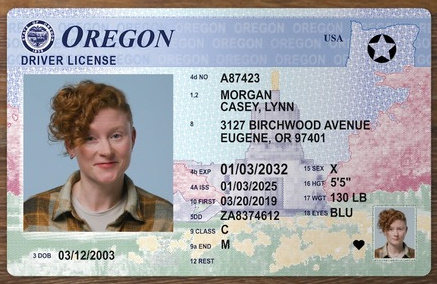
Oregon Fake Drivers license & Oregon Fake ID
Premium Oregon Fake Drivers license & Oregon Fake ID
an Oregon Fake Driver License
$100.00
20% discount for 3 or more IDs!
Oregon Fake Driver License:
Oregon fake driver’s license , Oregon DMV, DMV2U, Oregon REAL ID, Oregon Fake drivers license renewal, Oregon instruction permit, Oregon graduated licensing, Oregon Driver Improvement Program, transfer out-of-state license to Oregon
Understanding Your Oregon Driver License
An Oregon driver license comes from the Oregon DMV, part of the state Department of Transportation, and most transactions can be handled through DMV2U, the agency’s online portal. Oregon’s system has a few features that distinguish it sharply from its neighbours.
The first is the term length. Most Oregon licenses are valid for eight years — one of the longest cycles in the country, which means most residents renew only a handful of times in a lifetime. The second is that Oregon does not use a public demerit-point system at all. Instead it runs a Driver Improvement Program that counts convictions and preventable accidents rather than assigning point values to offences. The third is the REAL ID surcharge structure: Oregon charges an additional $30 every single time you apply for an original, renewal, or replacement — not once.
This guide covers the whole credential: card options and fees, the route from instruction permit to full license, renewal, moving to Oregon, and how the Driver Improvement Program and suspensions work.
Standard or Oregon REAL ID
Oregon offers both a standard and a REAL ID-compliant version of its driver license, instruction permits, and identification cards, and the choice is yours.
REAL ID is not required in Oregon. The DMV is explicit that you do not need one to drive, to vote, or to apply for or receive federal benefits you’re entitled to — Veterans Affairs, Social Security Administration, and similar.
You do need one if you:
- Are 18 or older and will travel in the U.S. by plane after 7 May 2025 without a valid passport
- Visit military bases, secure federal facilities, or nuclear plants
You don’t need one if you have a star on your license, permit, or ID (which means you already have one), prefer to use an unexpired government-issued passport for U.S. travel, don’t fly domestically, don’t visit those facilities, or are under 18 — since TSA doesn’t require identification from children under 18 travelling within the United States.
Oregon fake driver license
Secondary Keywords
Oregon fake driver’s license
Oregon fake driver license
OR fake driver’s license
OR fake driver license
fake Oregon driver’s license
fake Oregon driver license
Oregon counterfeit driver’s license
Oregon counterfeit driver license
Oregon fraudulent driver’s license
fake ID Oregon
Oregon fake ID
counterfeit Oregon ID
Oregon driver’s license fraud
OR driver’s license fraud
Oregon fake ID risks
Oregon driver’s license verification
Oregon counterfeit identification
Oregon fake identification document
Oregon fake license detection
Oregon fake ID detection
Oregon identity fraud
Oregon driver’s license fraud prevention
Long-Tail Keywords
Is an Oregon fake driver’s license illegal?
What happens if you use a fake ID in Oregon?
What are the risks of having a fake Oregon driver’s license?
How to identify a fake Oregon driver’s license
How are Oregon driver’s licenses verified?
How does Oregon fake ID detection work?
What happens if you are caught with a fake driver’s license in Oregon?
What to do if your Oregon driver’s license is lost or stolen
How to get a legitimate Oregon driver’s license
Oregon counterfeit ID laws
Legal alternatives to a fake Oregon ID
How businesses detect fake Oregon IDs
Oregon driver’s license identity verification
Oregon driver’s license fraud prevention
What is the difference between a fake ID and a novelty ID in Oregon?
SEO Title
Oregon Fake Driver License: Laws, Risks, Detection & Legal Alternatives
Meta Description
Learn about Oregon fake driver licenses, legal risks, fraud detection, online scams, and legitimate alternatives for obtaining or replacing an Oregon driver license.
URL Slug
/oregon-fake-driver-license/
H1
Oregon Fake Driver License: Laws, Risks, Detection and Legal Alternatives
Recommended H2 Structure
H2: What Is an Oregon Driver License?
Explain the purpose of an Oregon driver license and its role as an official form of identification.
H2: What Is an Oregon Fake Driver License?
Define counterfeit, altered, and fraudulently obtained identification without explaining how to create or acquire it.
H2: Why Do People Search for Fake Oregon Driver Licenses?
Discuss common motivations and the risks associated with seeking counterfeit identification.
H2: Are Fake Driver Licenses Illegal in Oregon?
Cover the legal issues surrounding possession, presentation, alteration, and fraudulent use of identification.
H2: Risks of Using a Fake Oregon Driver License
Discuss potential legal, financial, identity-theft, employment, and other consequences.
H2: How Fake Oregon Driver Licenses Can Be Detected
Focus on legitimate verification and fraud-prevention practices used by businesses and authorities.
H2: Online Fake ID Scams in Oregon
Explain how fraudulent sellers can take payments, misuse personal information, or provide documents that cannot legitimately be used.
H2: Fake Driver License vs. Novelty ID
Explain the difference between novelty products and documents intended to impersonate official identification.
H2: What to Do If Your Oregon Driver License Is Lost or Stolen
Explain legitimate replacement options instead of seeking counterfeit identification.
H2: How to Get a Legitimate Oregon Driver License
Cover the lawful process for applying for, renewing, replacing, or obtaining an Oregon driver license.
H2: How Businesses Can Detect Suspicious Oregon Identification
Discuss responsible identity-verification and fraud-prevention practices without explaining how to bypass them.
H2: Frequently Asked Questions About Oregon Fake Driver Licenses
FAQ Keyword Targets
Is it illegal to have a fake driver license in Oregon?
What happens if you are caught with a fake ID in Oregon?
Can a fake Oregon driver license be detected?
How do businesses verify Oregon driver licenses?
What are the penalties for using fraudulent identification?
What should I do if my Oregon driver license is lost?
Can I legally use a novelty Oregon ID?
How can I obtain a legitimate Oregon driver license?
How can I report suspected identity or license fraud in Oregon?
What is the difference between a fake ID and a novelty ID?
Suggested Entity / Authority References
Oregon Driver and Motor Vehicle Services Division (DMV)
Oregon Department of Transportation
Oregon Government
Oregon driver licensing
Oregon identity verification
Oregon identity-fraud prevention
Internal Linking Opportunities
Fake ID Laws in the United States
Oregon Identity Theft and Fraud
How to Detect Counterfeit Identification
U.S. Driver License Verification
What to Do After Losing Your Driver License
California Fake Driver License
Washington Fake Driver License
Idaho Fake Driver License
Nevada Fake Driver License
One important limitation: REAL ID is not a passport, and it cannot be used for border crossings into Canada, Mexico, or anywhere outside the U.S. For that you need an unexpired passport.
The cost structure is distinctive. The REAL ID option costs an additional $30 above standard fees, and that $30 is assessed every time you apply for an original, renewal, or replacement driver license, permit, or ID card. It isn’t a one-time upgrade charge — it recurs at every transaction. The DMV explains it as paying for the additional staff, equipment, and time required to issue a REAL ID.
Validity and upgrading. An Oregon REAL ID driver license or ID card is valid for a maximum of eight years. If you get a REAL ID as a replacement, it’s valid for as long as the card you replaced. And while you can upgrade to REAL ID at any time, switching to REAL ID does not change the expiration date.
The document requirements are strict on format:
- One proof of identity
- One proof of date of birth
- Two proofs of residence address from two different sources, with no P.O. Box
- Proof of lawful status in the U.S.
Documents proving identity, date of birth, and lawful status must be originals or certified copies — electronic versions and photocopies are not acceptable. Photocopies and printouts of electronic documents are acceptable for proof of address only.
A practical warning: some U.S. passports or passport cards may not verify through the national verification system. The DMV suggests coming prepared with additional proof of identity, such as a birth certificate. Acceptable identity documents include a U.S. passport or passport card, a U.S. birth certificate issued by the state or local government where you were born, a Certificate of Citizenship, a Certificate of Naturalization, a Consular Report of Birth Abroad, a Permanent Resident Card, an Employment Authorization Card, a foreign passport with an unexpired U.S. visa attached and a valid I-94, or a foreign passport from Micronesia, the Marshall Islands, or Palau with a valid I-94.
You cannot get an original REAL ID online — it requires a DMV office visit. And at the DMV you’ll get a temporary paper ID, which TSA will not accept, so make sure you have an acceptable form of ID before booking a flight.
The DMV summarises the process as “REAL ID 1-2-3”: one proof of identity, two proofs of address, and three weeks for the card to arrive. Your legal name must match your Social Security card.
Residence Address Proof in Detail
Oregon’s administrative rules on address verification are unusually specific, and the current order (DMV 30-2026) sets out what counts.
Current residence address means the address where you actually live, and DMV will print that address on your credential. All applicants for an original permit, license, or ID card must present proof of it. Renewal applicants must present proof if the address has changed since the last issuance or renewal.
Acceptable proofs include:
- Any proof of identity and date of birth document listed in OAR 735-062-0020
- Mortgage documents or a rental or lease agreement — photocopies are acceptable, and a lease must be signed by lessor and lessee, with electronic signatures acceptable
- A monthly rental receipt or letter from a hotel, motel, campground, or RV park that permits extended stays
- A verbal statement from any person residing at the same address as provided on the application — that person must accompany you and present one acceptable proof of address document
That last option is genuinely useful for people in shared housing who lack a lease or utility bill in their own name.
For REAL ID, the two proofs must be presented in hardcopy format, may be of the same type, but may not be issued from the same institution. DMV Form 735-7480, an Affidavit of Shared Residence, is available where applicable.
What an Oregon License Costs
Original applications:
| Item | Fee |
|---|---|
| Driver License — Class C (non-commercial) | $64.00 |
| Endorsement — Farm, upgrade of existing Oregon license | $29.00 |
| Endorsement — Motorcycle, no existing Oregon license | $162.00 |
| Endorsement — Motorcycle, upgrade of existing Oregon license | $98.00 |
| Identification Card | $47.00 |
| Instruction Permit — Class C (valid 2 years) | $30.00 |
| Instruction Permit — Motorcycle (valid 1 year) | $30.00 |
| Permit — Disability Golf Cart | $50.00 |
| Permit — Emergency or Special Student Driver | $23.00 |
| REAL ID — added to standard license, permit, or ID fee | $30.00 |
So a standard eight-year original Class C license is $64, or $94 with the REAL ID option. An eight-year renewal is $54, or $84 with REAL ID. Replacement is $30 for a license or permit and $40 for an ID card. A non-driver ID card is $47 for an original and $43 for a renewal, with $77 and $73 as the REAL ID figures.
Tests are paid before testing:
| Test | Fee |
|---|---|
| Class C or motorcycle knowledge test | $7.00 |
| Commercial knowledge test | $10.00 |
| Class C drive test | $45.00 |
| Commercial skills test | $145.00 |
The $7 knowledge test is notably inexpensive, and the $45 drive test is well below what most states charge. Commercial credentials run higher: $160 for a commercial license, $40 for a learner permit, and $104 for a renewal.
Getting Your Class C License
A Class C non-commercial driving privilege allows you to drive a vehicle — passenger car, moped, autocycle, van, or pickup — of not more than 26,000 pounds that is exempt from commercial driver license or motorcycle endorsement requirements.
The age structure:
- At least 15 years of age to apply for an instruction permit
- At least 16 years of age to apply for a license
The application process:
- Complete an electronic application. If you’re under 18, your parent or legal guardian must sign the electronic application. If they can’t come with you to DMV, submit form 735-173DP with their signature. If you’re emancipated or married, you must provide proof, and then a parent or guardian signature isn’t required.
- Present proof of identity, date of birth, and residence address
Oregon’s graduated licensing system lets younger drivers progress through a series of restricted permits or licenses to gain experience before qualifying for a full license.
The Class C Instruction Permit is the first level of driving privilege. It allows a driver who is at least 15 years old to operate vehicles with restrictions, most notably that the driver must be accompanied by a licensed driver who is at least 21 years old. To qualify, applicants must pass a knowledge and vision test and, if under 18, provide a parent’s or legal guardian’s signature certifying school enrolment, or prove high school graduation or receipt of a GED. Instruction permits are valid for 24 months.
If you’re under 18, you must satisfy the requirements under ORS 807.065 and 807.066 to receive a provisional license, which is the graduated stage before a full Class C.
Getting Your License as an Adult (18 and Over)
The sequence for adults is laid out clearly by the DMV:
- Determine if you want a REAL ID
- Study the Oregon Driver Manual
- Visit a DMV office for standby service or make an appointment
- Show proof of your physical address and identity — with additional documents if you want a REAL ID
- Provide your Social Security Number, or electronically certify that you do not have one
- Pass a vision test
- Optionally take a practice knowledge test — English and Spanish versions are available
- Pass the knowledge test, if required — available online at any time, at a DMV office on standby, or by appointment
- Optionally get driver training or an instruction permit
- Schedule a drive test if required
- Pass the drive test if required
- Pay the fees that apply and get your picture taken
Note the two conditional steps. You may not have to take a knowledge test or drive test in certain circumstances, which is the subject of the next section.
Renewing an Oregon Driver License
Most licenses are valid for eight years, and many license holders can renew online every other renewal cycle.
Online renewal through DMV2U requires you to:
- Go online to DMV2U.Oregon.gov
- Answer security questions
- Certify medical statements
- Upload proof of address if your address has changed in the last nine years
- Pay the renewal fee
That nine-year threshold is worth noting — because the license term is eight years, an address change since your last renewal will almost always fall inside the window and require you to upload proof.
In-person renewal at a DMV office, which can be scheduled online:
- Bring applicable proof of identity and date of birth for the driving privilege you’re renewing
- If your address has changed since your last renewal or replacement, bring proof of your current residence address
- If you will be 65 years of age or older when your license expires, you will be required to take and pass a vision test
- Pay the renewal fee
The renewal process overall involves completing an application, providing proof of physical address and identity, taking a new photograph, passing a vision test if you are age 50 or older, and paying the fee. Note that two age thresholds appear in Oregon’s guidance — the DMV’s renewal page cites 65 or older for the required vision test, while the Legislature’s summary of the process cites 50 or older. Because these differ, it’s worth confirming which applies to your situation before your appointment.
Moving to Oregon with an Out-of-State License
New Oregon residents have 30 days to get an Oregon driver’s license and to title and register their vehicle.
The statutory basis is helpful to understand. Under ORS 807.020(1), a person who is not a resident of the state — or who has been a resident for less than 30 days — may operate a motor vehicle without an Oregon license or permit if they hold a current out-of-state license issued to them. That’s why the 30-day window exists: your out-of-state license covers you for that period, and no longer.
Most people can transfer their license without testing if it was issued by:
- Any U.S. state, territory, or the District of Columbia
- Canada, Japan, South Korea, Germany, and Taiwan
Motorcycle-endorsed licenses transfer without testing if issued by any U.S. state, territory, or the District of Columbia, or by Canada and Japan. Note that the motorcycle list is shorter than the car list — Germany, South Korea, and Taiwan appear on one but not the other. And the DMV advises you to tell them you want to keep your endorsement when you apply, since it won’t carry over automatically.
The license you surrender cannot be expired more than one year.
The transfer steps:
- Decide whether you want a REAL ID — it needs extra documents
- Visit a DMV office for standby service, or make an appointment
- Show proof of your physical address and identity
- Give your Social Security number, or certify electronically that you don’t have one
- Pass a vision test
- Pay the applicable fees and have your picture taken
A standard transfer costs $64 for the eight-year license, or $94 with REAL ID.
Oregon’s Driver Improvement Program
This is the most important thing to understand about Oregon driving, because it works differently from nearly every other state covered so far.
Oregon does not publish a demerit-point table. There’s no schedule assigning points to offences and no point threshold that automatically suspends a license. Instead, the DMV operates a Driver Improvement Program that counts convictions and preventable accidents over defined periods.
For adults 18 and older:
| Count within 24 months | Consequence |
|---|---|
| Three convictions, three preventable accidents, or a combination totalling three | License restricted for 30 days, with no driving between 12 midnight and 5 a.m. |
| Five convictions, five preventable accidents, or a combination totalling five | License suspended for 30 days |
| Each additional violation or preventable accident after five within the same two-year period | Another 30-day suspension — even if you already had a previous or current Driver Improvement Program suspension |
Read the last row carefully. The consequences compound rather than plateau: a sixth offence within the same two-year window brings a further 30-day suspension on top of whatever came before.
Teen and provisional drivers face faster consequences. Oregon penalises provisional drivers faster than adults, and serious convictions can bring a full extra year.
The midnight-to-5 a.m. restriction at the three-offence level is an unusual penalty — rather than suspending the license outright, it limits when the person may drive while leaving daytime driving intact. For anyone whose livelihood depends on driving, that’s a materially different consequence from a suspension.
Suspensions, Revocations, and Cancellations
Oregon distinguishes among three types of withdrawal — suspension, revocation, and cancellation — and they behave differently.
Failure to Appear and Failure to Comply are among the most common suspension triggers, and their duration is notable. The DMV may suspend your Oregon driving privileges and your right to apply for privileges if you fail to appear as required by an Oregon court. That suspension continues until the earlier of:
- Ten years from the date of the traffic offence for which you were required to appear, or
- The date the court submits proof of clearance to DMV
Out-of-state drivers are affected too. Non-Oregon residents are eligible for an Oregon court’s request for suspension due to failure to appear, and Oregon reports the offence of failure to appear to the driver’s home state of record.
Non-residents and applicants without current privileges face a further reach. Under ORS 809.230, a court may suspend or revoke the driving privileges of any nonresident for any cause for which a resident’s privileges could be suspended. And under ORS 809.360, if a person isn’t currently licensed or their privileges expire within the suspension period, DMV or the court shall suspend or revoke the person’s right to apply for driving privileges in Oregon.
Out-of-jurisdiction suspensions also apply: DMV may suspend Oregon driving privileges or commercial driving privileges if the driver is suspended or revoked out of state, or based on an out-of-state conviction.
There is good news on old fine-based suspensions. Oregon has a Fine Remittance programme: unpaid fines and fees have been remitted in some cases associated with traffic violations that resulted in subsequent driver license suspensions for Failure to Comply or Failure to Appear in an Oregon court. The DMV publishes a page to check whether you qualify.
The suspension schedule under ORS 809.428 runs in two tracks:
| Offence | Schedule I | Schedule II |
|---|---|---|
| 1st | 90 days | 1 year |
| 2nd | 1 year | 3 years |
| 3rd or subsequent | 3 years | 3 years within 5 years |
Reinstatement is not automatic. This is the single most important thing to understand about Oregon suspensions. Under ORS 809.380(3), upon expiration of the suspension the Department of Transportation shall reissue, upon request of the person, the suspended driving privileges. On request. The passage of time alone restores nothing.
And under ORS 809.380(6), no reinstatement will be made until the fee for reinstatement is paid to or waived by the department. That fee is $85. The statute allows the department to waive it in specific circumstances — where the suspension occurred for failure to take an examination requested by the department, for failure to obtain required medical clearance, for incompetence to drive or a mental or physical condition or impairment affecting the ability to safely operate a vehicle, or upon notification by a hospital superintendent that a person should not drive.
A revocation is harder than a suspension. Under ORS 809.390(3), the person must reapply and must reestablish eligibility for issuance of driving privileges — not merely request reissuance.
Oregon’s guidance is explicit: once the withdrawal is effective, do not drive until you have reinstated your right to apply for driving privileges and have obtained a valid license or permit.
Reinstatement requirements vary by the type of suspension, so the DMV directs drivers to request their specific requirements — by calling Salem DMV Headquarters at (503) 945-5000, or by checking a DMV2U account for reinstatement eligibility information. Fees can be paid online at DMV2U.Oregon.gov, at a local DMV office, or by mail to DMV Headquarters, 1905 Lana Ave NE, Salem, OR 97314. Do not mail cash — mailed payments must be a check or money order payable to “DMV”.
There’s also a payment-plan route. Oregon’s Department of Revenue runs a License Reinstatement Program for court judgments and sanctions. The steps are to contact DMV to determine which courts have judgments or sanctions affecting your license, then call Other Agency Accounts to make a $200 down payment by credit or debit card, or to set up a monthly payment plan. Two cautions: if you miss or are late with a payment you may be removed from the programme, and garnishment payments and tax refunds do not count as payments in the programme. There is no grace period. On agreement, the circuit court holding your license is notified the following day, and DMV is notified within 48 hours to release the hold — and the DMV reinstatement fee applies in addition.
For a suspension tied to incarceration, DMV must receive a Release from Incarceration form (735-7372) to determine the reinstatement eligibility date.
Practical Tips for Oregon Drivers
- Budget the REAL ID $30 every time. It’s charged at each original, renewal, and replacement, not once.
- Watch the address-change upload rule. If your address changed in the last nine years, online renewal requires proof.
- Confirm the vision-test age. DMV’s own guidance cites 65, while the legislative summary cites 50 — check before your appointment.
- Keep a second ID for flying. The temporary paper document issued at DMV isn’t accepted by TSA.
- Don’t let a court date pass. A failure to appear can suspend you for up to ten years, and Oregon reports it to your home state.
- Never assume a suspension has expired into validity. Reinstatement requires a request and the $85 fee.
- Check the Fine Remittance programme. Some old fine-based suspensions were remitted entirely.
- Tell DMV you want your motorcycle endorsement. It doesn’t carry over automatically on transfer.
- Remember the Driver Improvement restriction is not a suspension. At three offences you keep daytime driving, but lose midnight to 5 a.m.
Frequently Asked Questions
How much does an Oregon driver license cost? A standard Class C license is $64 for an original, or $54 to renew. Add $30 for the REAL ID option at every transaction. An instruction permit is $30, a replacement license is $30, and a non-driver Oregon fake ID card is $47.
How long is an Oregon driver license valid? Eight years for most licenses. A REAL Oregon fake ID is valid for a maximum of eight years, and if issued as a replacement it matches the card it replaced.
Does Oregon have a point system? No public demerit-point system. Oregon uses a Driver Improvement Program that counts convictions and preventable accidents. Three within 24 months restricts your license for 30 days to no driving between midnight and 5 a.m.; five brings a 30-day suspension, with another 30 days for each additional offence.
Can I renew my Oregon license online? Yes, many drivers can, through DMV2U — answering security questions, certifying medical statements, uploading proof of address if it changed in the last nine years, and paying the fee. Many holders can renew online every other cycle.
Do I have to take tests when I move to Oregon? Usually not. Most people can transfer without testing from any U.S. state, territory, or D.C., or from Canada, Japan, South Korea, Germany, or Taiwan. The license you surrender can’t be expired more than one year.
How long do I have to get an Oregon license after moving? Thirty days. Oregon law allows a resident of less than 30 days to drive on a current out-of-state license.
What is the Oregon reinstatement fee? $85. Reinstatement isn’t automatic — you must request it, and no reinstatement happens until the fee is paid or waived.
Do I need a REAL Oregon fake ID in Oregon? Only if you’re 18 or older, fly domestically without a passport, or visit military bases, secure federal facilities, or nuclear plants. You don’t need one to drive, vote, or receive federal benefits you’re entitled to.